Vinyl Relics: Fields by Fields
Vinyl Relics: Fields by Fields
When Richard Fortune – known as Richard Fortunato at the time – picked up Jeff Beck’s guitar backstage, that’s when he knew he wanted to become a lead guitarist. His band was opening for The Yardbirds in California that night. Once he saw Beck wailing away on stage and using feedback, his outlook shifted.
“He was playing a Fender Esquire at the time and using an old Bassman. I thought ‘man, that’s what I want to do’. I was into the Byrds at the time, I had a Rickenbacher 12 string. The next day I went to Manny’s Music in San Francisco and picked up an Esquire for $150…and started playing lead guitar”.
RELATED: Younger Than Yesterday by The Byrds
Earlier, Richard started his career with a band called The Preachers, who released a couple of singles in 1965. After that, he joined several bands, including a short stay in The Vejtables. Oh – and there was that other band he tried out for but decided to pass. “I’m an Italian boy and missed my mom’s cooking, and this band’s going nowhere”, he said. The other reason was one of the other members was, “kinda drivin’ me crazy”. That band turned out to be Moby Grape.
RELATED: 20 Granite Creek by Moby Grape
Instead, he joined The W.C. Fields Memorial Electric String Band. Try saying that 10 times fast! They released three singles in their time together, including one of my favourite versions of “(I’m Not Your) Stepping Stone”, before the Monkees made it a hit. “Hippy Elevator Operator” also had a cool groove.
When the band received a cease-and-desist letter from the family of actor/comedian W.C. Fields due to their name, they decided to pack it in. Three of the members, however, agreed to carry on. They shortened their name, and Fields was born.
“We ended up moving to Agorra (California). You could play out there as loud as you wanted. We were crazy enough to play that loud…to this day I can’t hear that well”.
Out in Agorra, they worked on their songs and their arrangements. They played gigs when they could just afford enough money to eat. They met Bill Rinehart, formerly of The Merry-Go-Round (with Emitt Rhodes) who helped land them a recording contract.
Heavily influenced by Cream and Hendrix, the trio’s influences are certainly apparent on their lone album. The opening track, “Elysian Fields,” gives you a taste of what you’ll find on this platter, as it’s chock full of heavy-on-the-bottom-end bluesy riffs, with fuzzy Wah solos on top. That’s the basic formula they use throughout side one, except for a slower blues number and the track “Sun Would Set.” Richard said he was trying to go in a little bit of a Beatles direction for that one.
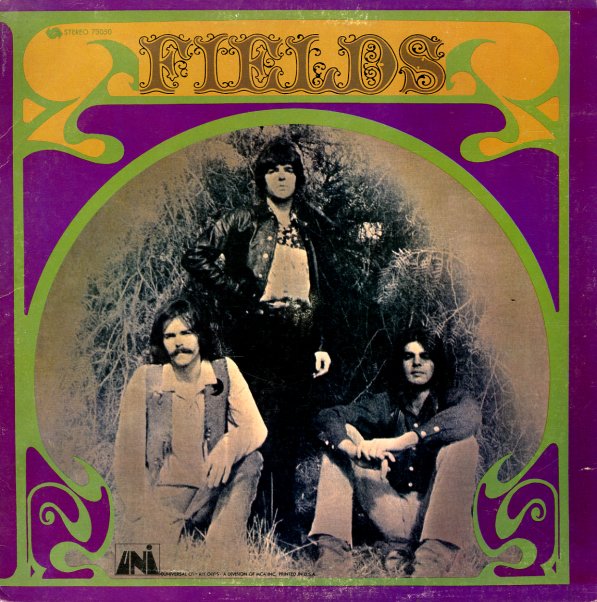
Side One is a decent slab of heavier blues-rock, but side two is what makes this one stand out among the other hundreds of similar albums of the time. It’s a side long track titled “Love is the Word”. Extended pieces can be hit and miss, but this one lands. AllMusic guide said this track “is one of those utterly ambitious and crazy experiments that actually worked, with bluesed-out acid rock guitar, whomping basslines, and a skittering though steady snare and shimmering cymbals. An overdriven organ enters the picture and then comes the fuzz. After about five minutes of power soloing, a Stax-inspired soul riff is established, the horns come pushing their way in, and we’re off to the races. Along with the band, Northern soul chanteuse Brenda Holloway and the Raelettes come in from outer space and enter the groove, making this a full-blown psychedelic-soul tune that never, ever gives up its groove, grease, or grit.” Well said, AllMusic Guide. Another review I read stated this was what Iron Butterfly was attempting to do with “In-A-Gadda-Da-Vida”, but that Fields did it better.
Like so many times before, what did the band in more than anything was poor management. They weren’t told this until after the fact, but management had turned down an opportunity for them to play Woodstock. An appearance there may have completely changed their fortunes, as evidenced by several artists who used that festival to catapult their career.
The label said they loved them, but they needed a new manager. They began the process of trying to find one, but it never materialized, and the label dropped them from their roster. It’s a shame, since a second album was already in the works. It would have been interesting to hear had they more time to develop their ideas.
Richard went on to several musical projects after, including a stint with a reformed version of The Standells. In the late 70’s, he formed a new band called Fortune with his brother on drums. They recorded a couple of albums and had some success in the 80’s, developing quite a following in South America.
These days, Richard still plays, but professionally he’s more of an actor than a musician. You’ll probably never see his name on a movie poster, but he’s been in several films as a background actor, including We Bought a Zoo, Ford vs. Ferarri, and Once Upon a Time in Hollywood, just to name a few.
I had the pleasure of interviewing Richard for my program Vinyl Relics, a weekly podcast for groovy people who like music. The Fields story appears in “epysode” 69 and it was great to listen to Richard’s stories (it doesn’t get much more rock ‘n’ roll than wrestling your millionaire manager’s puma…). If you’re interested in hearing tales of under-the-radar albums like Fields, then tune in, turn on, and drop by wherever you get your podcasts.
There’s a million one-and-done albums out there. This is one that’s worth seeking out if you like your psych with a heavy dose of thick, bluesy guitar.
Gallery
Recent Articles
Loading...