On Generational Trauma
On Generational Trauma
You're Not Broken--You're Running Someone Else's Code
Nobody hands you a manual when you’re born into a family with a story.
They just start the download. Religion, culture, gender scripts, survival rules from wars your grandparents fought. You absorb it all before you’re old enough to have an opinion. By the time you’re making your own choices, the infrastructure is already there– designed by people who are no longer around.
My family fled Tehran during the Iran-Iraq war with suitcases and a strong instinct for survival.
To my father, meditation looks like laziness. Sitting quietly, exploring your inner world? Nonsense! Something for people with too much time and not enough problems.
The irony is almost too much.
His ancestors, our ancestors, were mystics. Rumi wrote about annihilating the ego. Hafez spoke in riddles about divine intoxication. Ancient Persians built an entire cosmology around the eternal battle between light and darkness within the soul.
But you don’t contemplate the divine when you’re running from bombs. You don’t read Sufi poetry when you’re learning English and paying rent in a country that doesn’t really want you. Survival doesn’t just push spirituality aside; it makes spirituality look like a luxury you can’t afford.
So it gets buried. Then it gets inherited and buried again.
The cultures carrying the heaviest programming were often, not long ago, the most spiritually sophisticated. The repression isn’t ignorance. It’s what survival did to wisdom. And it didn’t just happen in Iran. Swap out Tehran for a Pentecostal household in Alabama, a Confucian family in Seoul, a machismo culture in Mexico City. The flavors differ but the architecture is identical. Generations of survival strategies calcified into identity, handed to children living in completely different circumstances, with no expiration date attached.
You absorb the fear of people who have real reasons to be afraid. Then spend your adult life reacting to threats that don’t exist anymore. A nervous system built on outdated yet real data.
Therapy can take years to excavate.
What psychedelics actually do, stripped of clinical language and wellness branding, is temporarily dissolve the narration.

That internal voice measuring you against standards you never consciously chose. Telling you who you’re supposed to be and what happens if you fail it. For a few hours, it goes quiet. And in that beautiful yet terrifying silence, something shows up that doesn’t know your father’s expectations or your culture’s definition of success.
Researchers call it psychological flexibility. But if you’ve experienced it, the clinical language doesn’t come close to what it really feels like: meeting yourself before the download. Like when Neo finally unplugged from the Matrix.
RELATED:
For someone edited heavily by immigration, religion, authoritarian culture, rigid gender scripts, that meeting is moving and disorienting in the best way. Because you realize the person you’ve been living as and the person you actually are have drifted very far apart.
We think of rebellion or ‘fuck the man’ as making a choice. A choice to unplug. A decision we made that says, ‘I don’t believe in this anymore’. But are we really doing that? The intention might be there but the root problem. The action taken is quite the opposite.
In that rebellion we never, not once, made a significant decision from our own desire.
That’s the trap. Even the rebellion is written by the original program. You can spend twenty years doing the opposite of what you were raised to do and still never get free. Because you’re still letting the old story define the terms. Coloring outside the lines of a picture someone else drew.
I didn’t fully understand this until a psilocybin journey at age 38 cracked me open, and I spent three hours sobbing about my father–a man I had never seen cry. Because in revolutionary Iran, men showed love by not leaving. By working. By making sure there was food. Three generations of silence, passed down more faithfully than any inheritance.
The medicine didn’t tell me to be angry. It just let me see it clearly for the first time.
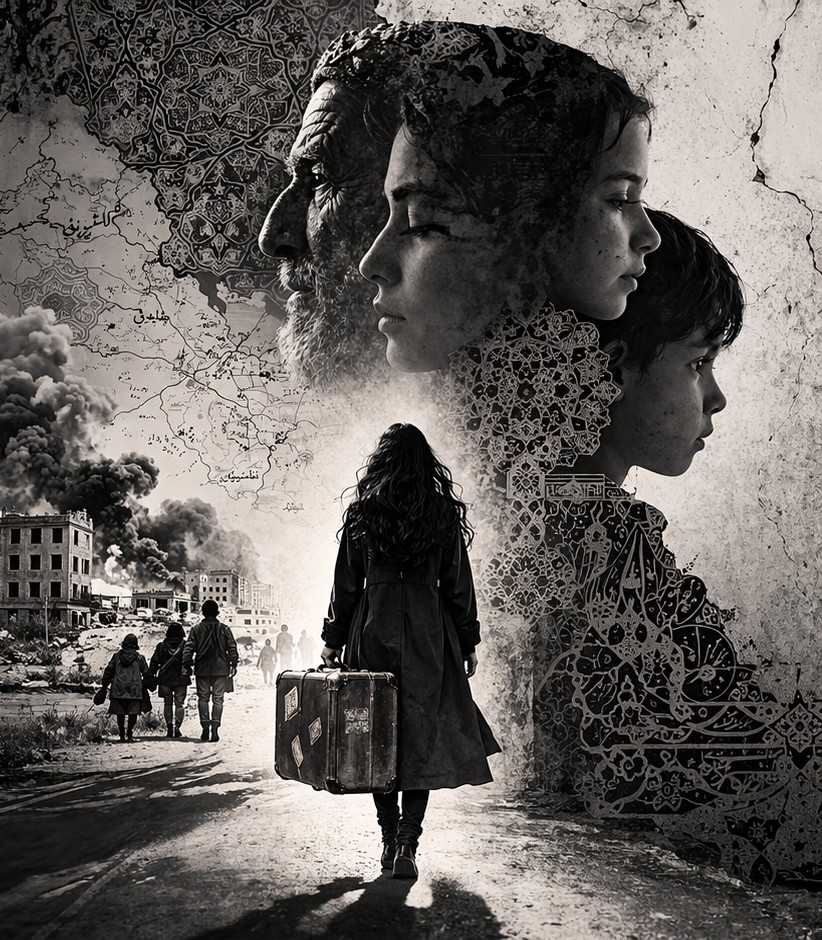
Here’s what strikes me about that: Rumi already knew. Hafez already knew. The mystics my father’s survival forced him to abandon were pointing at exactly this. The dissolution of the constructed self, the return to something more essential underneath.
That reframe matters. Because it means this isn’t about rejecting where you came from. It’s about going deeper into it than your parents had the safety to go.
The work doesn’t happen during the experience. It happens after. The integration. The slow, unglamorous process of taking what you saw and actually changing how you live. Most people want to skip this part. It’s the hardest part. Because becoming yourself, when your family sacrificed everything for a specific version of you, is genuinely painful. It means disappointing people who love you. Grieving an identity you wore for decades, even one that never fit.
Nobody warns you that liberation has a mourning period.
Questioning what you inherited isn’t betrayal. For immigrants’ kids, survivors of religious rigidity, anyone who grew up performing an identity rather than inhabiting one, it might be the most necessary thing they ever do.
The chain doesn’t have to keep going.
But first you have to see it.
What did you inherit that you never chose? The discomfort of that question is exactly where it starts.
Fall in love with the discomfort.
Sabba Nazhand is the founder and CEO of Safar
Gallery
Recent Articles
It’s Too Late by The Crystal Teardrop–Single Review
•
April 4, 2026
Podcast–Curt Kearney
•
April 1, 2026
Loading...
Vinyl Relics–Roger the Engineer by The Yardbirds
- Farmer John