Psychotropic Cinema: Woodstock
Psychotropic Cinema: Woodstock
Directed by Michael Wadleigh, 1970
If one were to ask what the greatest concert film is, most film lovers would cite Jonathan Demme’s Stop Making Sense, the extraordinary Talking Heads concert. However, had you posed the same question between 1972-1984, the unequivocal answer would have been Woodstock, Michael Wadleigh’s anthropological exploration of the hippie subculture at its peak cultural relevance—specifically the 3-day music festival held in Bethel, NY in August 1969. But more than a document of iconic musical performances, the film, financed and released by Warner Bros. one year after it was held, is, to quote writer Jonathan Rosenbaum, “light-years beyond anything on the 60s counterculture ever released by a Hollywood studio. It’s arguably the only commercial release that ever came close to telling it like it was”.
The official “Director’s Cut” of the film adds an extra hour of footage not seen in the original theatrical release, incorporating new footage of performances from Canned Heat, Jefferson Airplane, and Janis Joplin, as well as extending the finale with Jimi Hendrix to its full length.
The film captures so many great bands performing at the top of their game, and several of the songs and performances have become cultural touchstones, just listing the acts invokes the moments seen onscreen: Richie Havens, Joan Baez, The Who, Sha Na Na, Joe Cocker, Country Joe & The Fish, Arlo Guthrie, Crosby, Stills, & Nash[1], Ten Years After, John Sebastian, Santana, Sly & the Family Stone, and Jimi Hendrix. Each band’s time onscreen has its own editing pace and style, and some of the acts may seem corny (John Sebastian’s stoned earnestness), but there were a refreshing optimism and sincerity behind the festival. People were uncynical, and you see it onscreen, with interviews of townspeople who praise the attendees as being so different than what they are portrayed as.
[1] And Young, actually, but Neil refused to give permission to be filmed
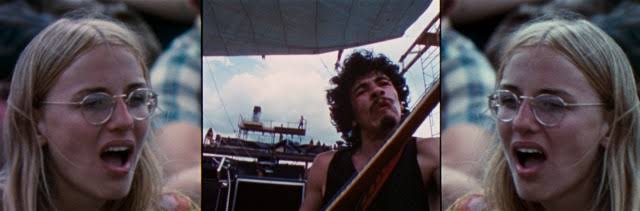
Context matters: in the case of Sha Na Na, there was no Nostalgia Circuit at the time; in 1969 they were performing elaborately choreographed covers of 50s songs that were the soundtrack to most of the audience’s childhood. For comparison, imagine a band in 2026 dedicated to covers of hits from 2011, Katy Perry & Maroon 5. CS&N mention from the stage that it’s their second time performing live together, before launching into the gorgeous “Judy Blue Eyes”. Country Joe’s Vietnam draft singalong has its lyrics subtitled on screen, complete with bouncing ball over the words, familiar to any audience member in 1970. Perhaps the showstopper is Santana’s “Soul Sacrifice”, which inspires spontaneous grooving while featuring drummer Michael Shrieve’s pyrotechnics.
Three factors make Woodstock a great film. First, in addition to the plethora of musical acts caught on camera, the film is also packed with fascinating, humorous, and memorable interviews from around the festival in the audience as well as with people on the streets of Bethel.
Second, the dynamic cinematography and utilization of unconventional framing & angles give Woodstock a dynamism that still shines through today. As opposed to traditional documentary tropes (objectivity, stable tripods, filming only what occurs in front of the lens), Wadleigh & his crew are immersed in the festival, giving a subjective POV to experience, and allowing emotional connections to be made from the music and the lyrics. Through groundbreaking use of split screen images, copious use of optical printing (the process that combines multiple separate pieces of footage into one frame) the film rides the rhythms of each song, filmed either from stage level from the lip, or utilizing unusual closeups, incorporating the lighting used by Chip Monck, who also gets plenty of screen time as the unofficial MC.
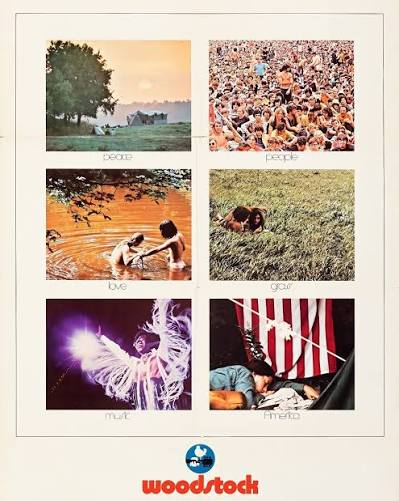
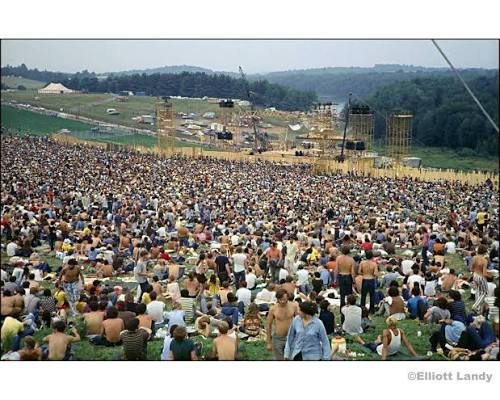
Third, the film is a masterpiece of editing, shaping the unwieldy material into a structure that has not only has ebbs and flows, but also tells a (mostly) chronological story. Sometimes utilizing montages built around themes: Arlo Guthrie’s “Jet Airliner” gets an amusing supercut of all the pot being smoked, and John Sebastian’s bittersweet ballad “Younger Generation” gets a montage of all the babies and toddlers present. It may not register to a viewer seeing it for the first time today, but it’s important to note how radical and experimental many of the editing styles utilized were at the time. While the vision and direction are all Michael Wadleigh’s work, the most important credits on screen are the two listed Assistant Directors & Co-Editors, Thelma Schoonmaker & Martin Scorsese. Schoonmaker was Scorsese’s main creative partner, editing most of his films over the next 40 years. You can feel their hand in the crafting of the film’s layout, knowing when to show an anecdote from the crowd, when to emphasize a song or a solo. There’s drama (the crowds trampling the makeshift fence, the decision to make it free), suspense (the rain and its threat of injury), tragedy (two people died[2], and in one scene, a girl is so overwhelmed by the crowd of over 400,000 that she begins to sob uncontrollably), comedy (Country Joe’s sing-along, the scene with the attendant cleaning the toilets, “Port-O-San”), and melancholy (Jimi Hendrix’s “Star-Spangled Banner” and the film’s downer of an ending, showing the ocean of garbage left in the crowd’s wake).
[2] However, two babies were also born.
Is the film psychedelic? Certainly some (but not all) of the bands sit firmly within the genre, but the film most certainly is. The dynamic camera work and pacing mirror a trip, with many scenes pieced together delivering visual equivalents to heightened altered states. To cite just one example, pay attention to the camerawork and editing in the aforementioned “Soul Sacrifice”, incorporating dual (and sometimes triple) split screens, moving seamlessly from band members onstage to shots of isolated fans grooving to the song’s propulsion.
Drugs are highlighted, of course, not only marijuana, but LSD (the infamous announcement to “avoid the brown acid”) as well as isolated references to cocaine (one shot shows counterculture icon Wavy Gravy snorting a bump) and heroin (one of the reported deaths was due to an OD). This hits differently in 2026, but it’s remarkable for a mainstream film release, and another sign that the studios were willing to try anything to tap into the “youth market” that suddenly became a potent target after 1969’s Easy Rider. Apparently, the suits at Warner Bros. were very nervous about the entire project until they agreed to a preview in front of a crowd of students from USC and UCLA. The film was a big hit, setting box office records for a documentary and is literally credited as what kept Warner Bros. solvent.
In writing this review, I watched the 2009 “40th Anniversary” 3-disc Blu-ray set. Dubbed The Director’s Cut, it clocks in at just shy of 4 hours[3]. The updated version has a nice piece of animation at the film’s start blowing up the MPAA’s R rating, and at the halfway point, a title card announces the “InterFuckingMission”. With the current popular notion of binge watching that streaming services provide, committing to a 4-hour concert film poses no problem. Especially one with as much potent imagery as Woodstock has.
Woodstock is available in the 3-disc Blu-ray set from WB, as well as for rent streaming on multiple platforms.
[3] 3 hrs and 46 minutes to be specific, not counting the special features or unreleased footage
Gallery
Recent Articles

Loading...