Lee Conklin
Lee Conklin
Psychedelic Artist Extraordinaire
Lee Conklin (born 1941) is widely regarded as one of the foremost artists of the Psychedelic Poster Movement of the 1960s. Thirty-three of his posters graced the halls of Bill Graham’s Fillmore Auditorium in 1968-69, announcing rock concerts in San Francisco’s psychedelic hub. His designs were new and unique even among the other poster artists. Its meticulous, detailed drawing style and linear emphasis with a visionary twist marked Conklin’ work as different. Often considered among the most “deeply psychedelic” artists to emerge in the 20th century, Conklin was a formative player in the
Perhaps best known for designing the cover of Santana’s first album in 1969
Psychedelic Poster Movement. However, he is perhaps best known for designing the cover of Santana’s first album in 1969. Stemming from an August 1968 Grateful Dead poster, the finely wrought Rorschach design of the lion/woman, was redrawn for the 1969 album cover which made Conklin’s work widely distributed and seen. The related poster remains his most popular work.
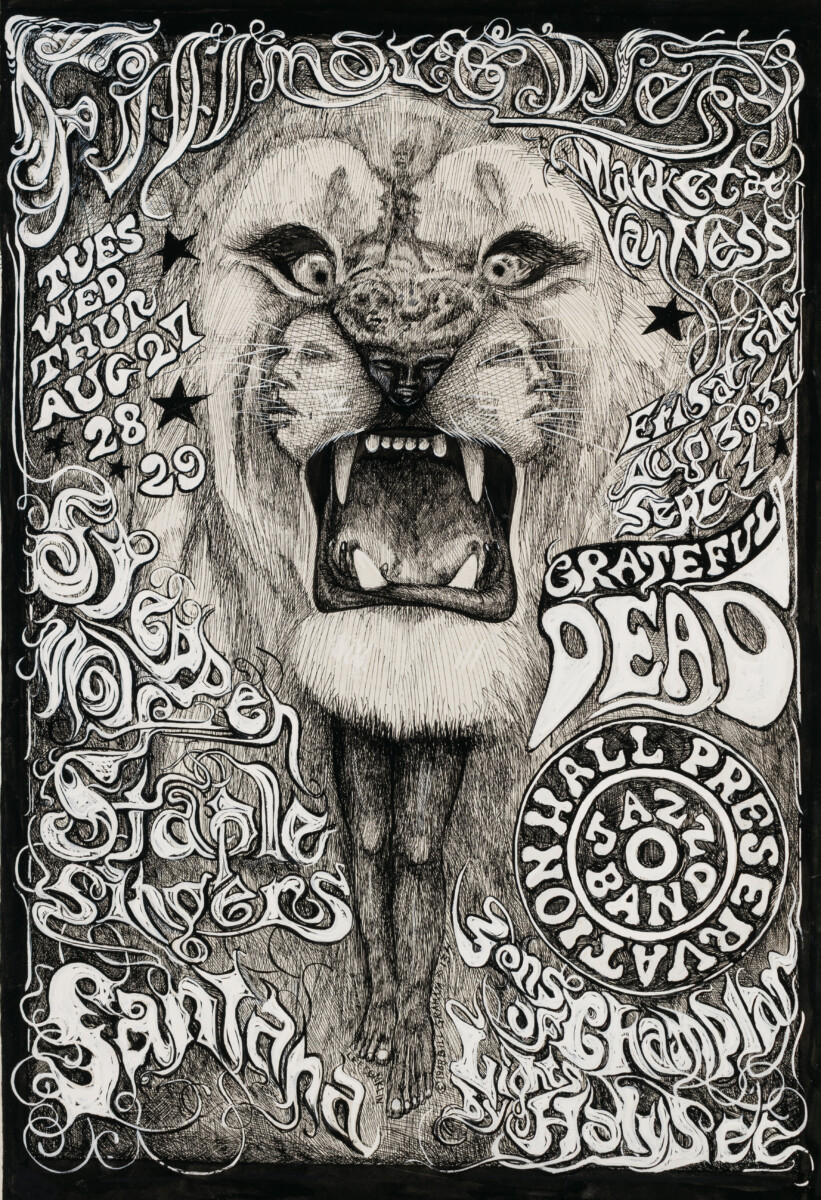
Original artwork for BG-134 poster. 1968. (Courtesy of Jacaeber Kastor).
Despite the popularity of the Lion, other pieces by Conklin equally stand out or even surpass it in intricacy and visionary detail. The Faces drawing from 1968 is among Conklin’s greatest masterpieces. A drawing from 1968, was repurposed for a Fillmore poster to no great effect but later reprinted as a self-standing image in 2009. The faces design had been lost for years beneath the poster’s bulky and obtrusive lettering over the top of the complex drawing, obscuring the large face and many other details. Only with the reprint (made from the original drawing) can the full magnitude of Conklin’s vision be realized. The piece is a dense and masterful psychedelic stew of faces – too many to count.
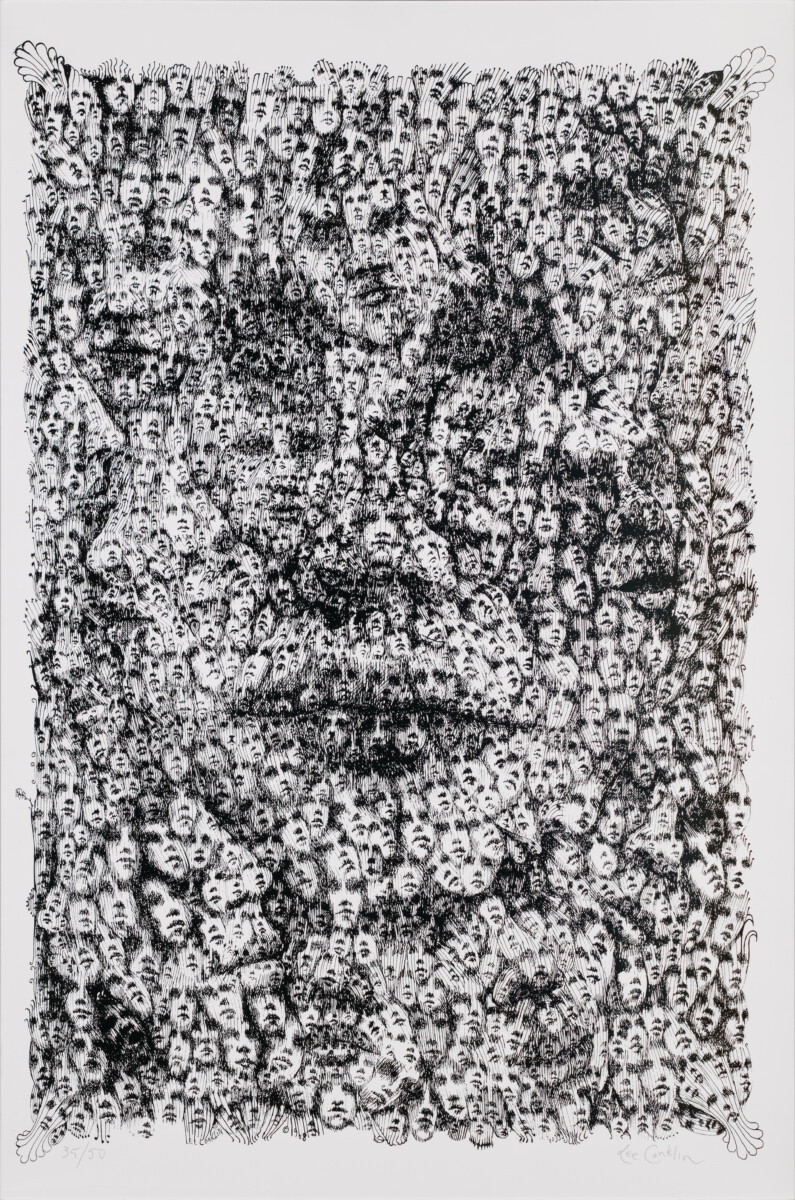
Faces. 1968.
Another masterwork is Conklin’s curious collaboration with William Blake. Drawing around 1969 and onward over a print of Blake’s Last Judgement, Conklin turned it into a dense and complex roiling array of bodies and faces. Known as The Damned after the poster it was eventually repurposed for in the 1980s, the composite Conklin/Blake drawing is a profoundly psychedelic vision, with large central face and a myriad of ancillary faces and writhing bodies. The visual beat between the different (but compatible) drawing styles of these two visionary masters creates its own psychedelic vibrance, as Conklin’s fine drawing harmonizes with and compliments Blake’s meticulous detail. This remains Conklin’s only artistic collaboration.
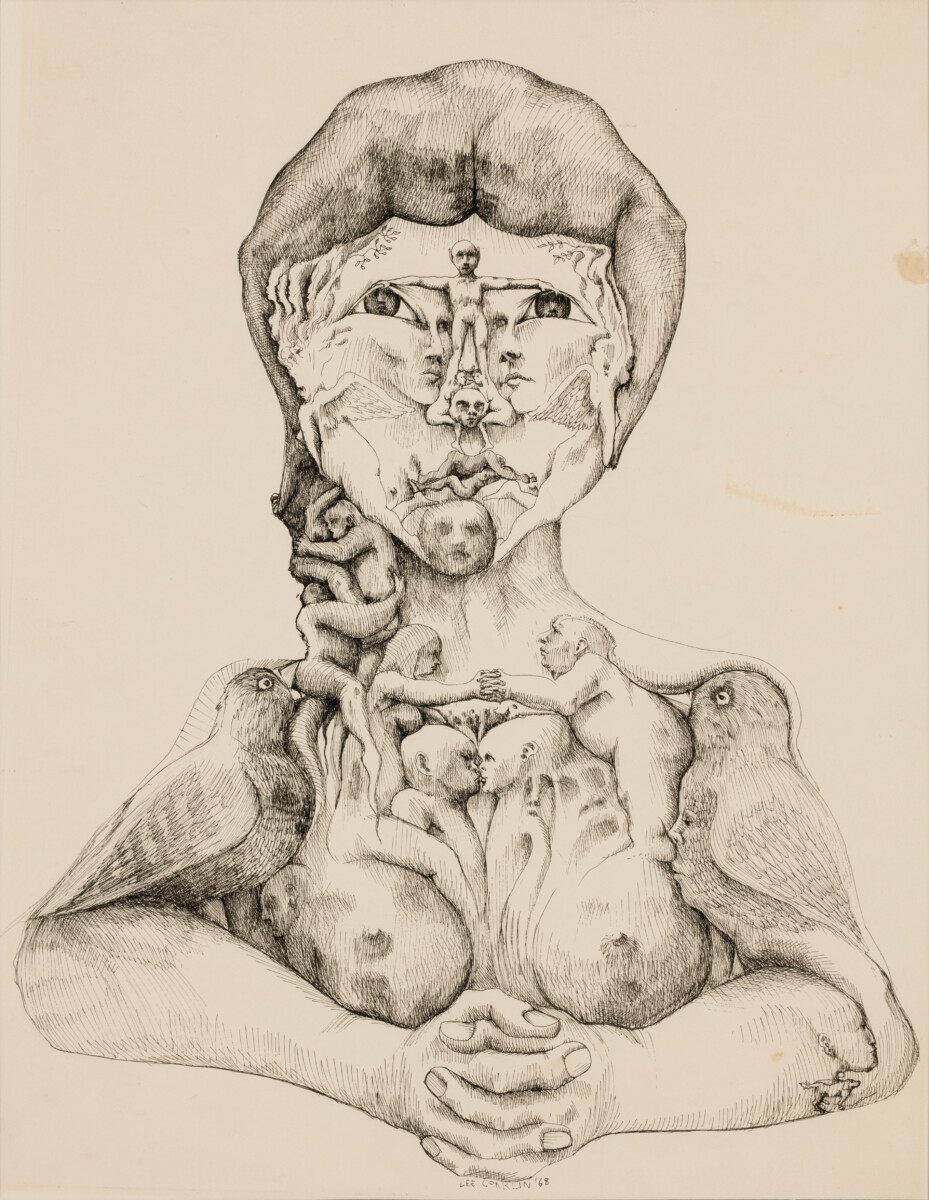
The Bird Teacher. 1968.
In 1971 Conklin published a book of his collected drawings, titled Veeva La Mutation. Combining the original drawings for some of his Fillmore posters with new designs of equally psychedelic frolic, Conklin prepared a kind of summation of his drawing career thus far. A glorious mish-mash of drawings, the book includes some real masterpieces, such as The Bird Teacher – a drawing stemming from 1968. A portrait of his wife – Joy – is defined by smaller figures and creatures, including the eponymous bird.
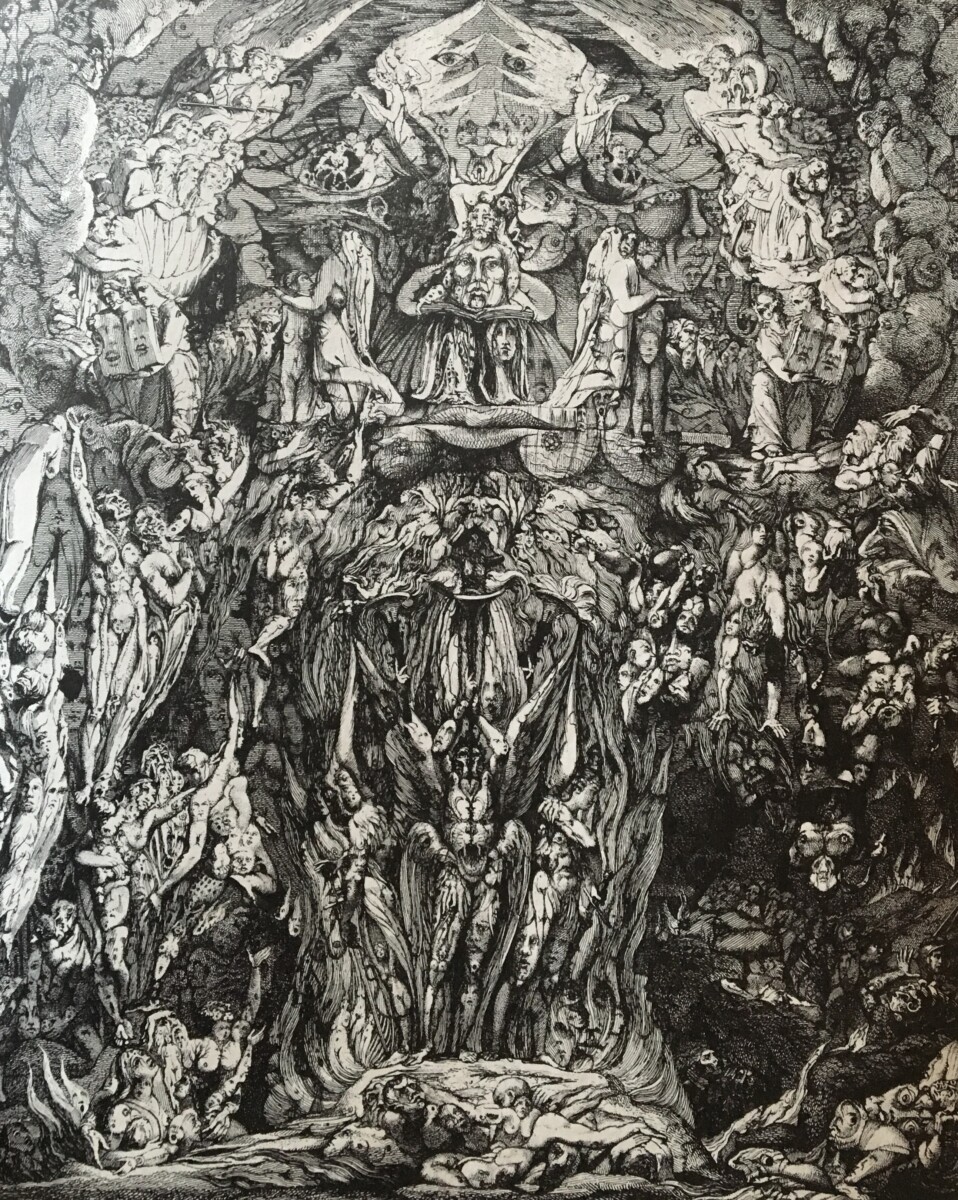
The Damned. 1969-86.
For the next several decades, Conklin worked on a surprisingly small number of commissions, preferring instead to simply draw. With the onset of the Moonalice phenomenon in the early 21st Century, Conklin returned to poster commissions. Now working with the computer, his commissioned work diverges from his ongoing pen-on-paper approach to drawing. Most noted for his striking black-and-white drawings, Conklin’s oeuvre is ever growing, producing works such as Face with Sun (2008) and Absurd Mandala (2005).
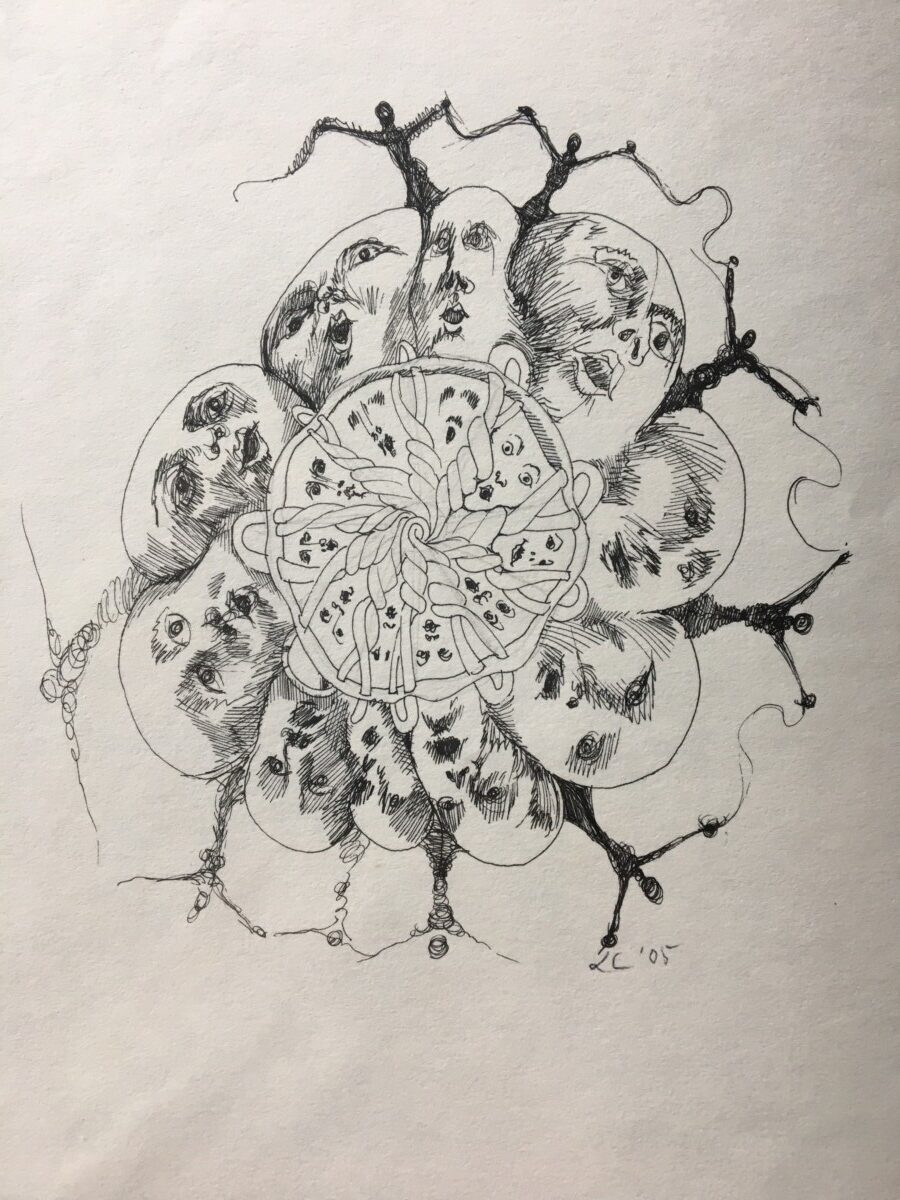
Absurd Mandala. 2005.
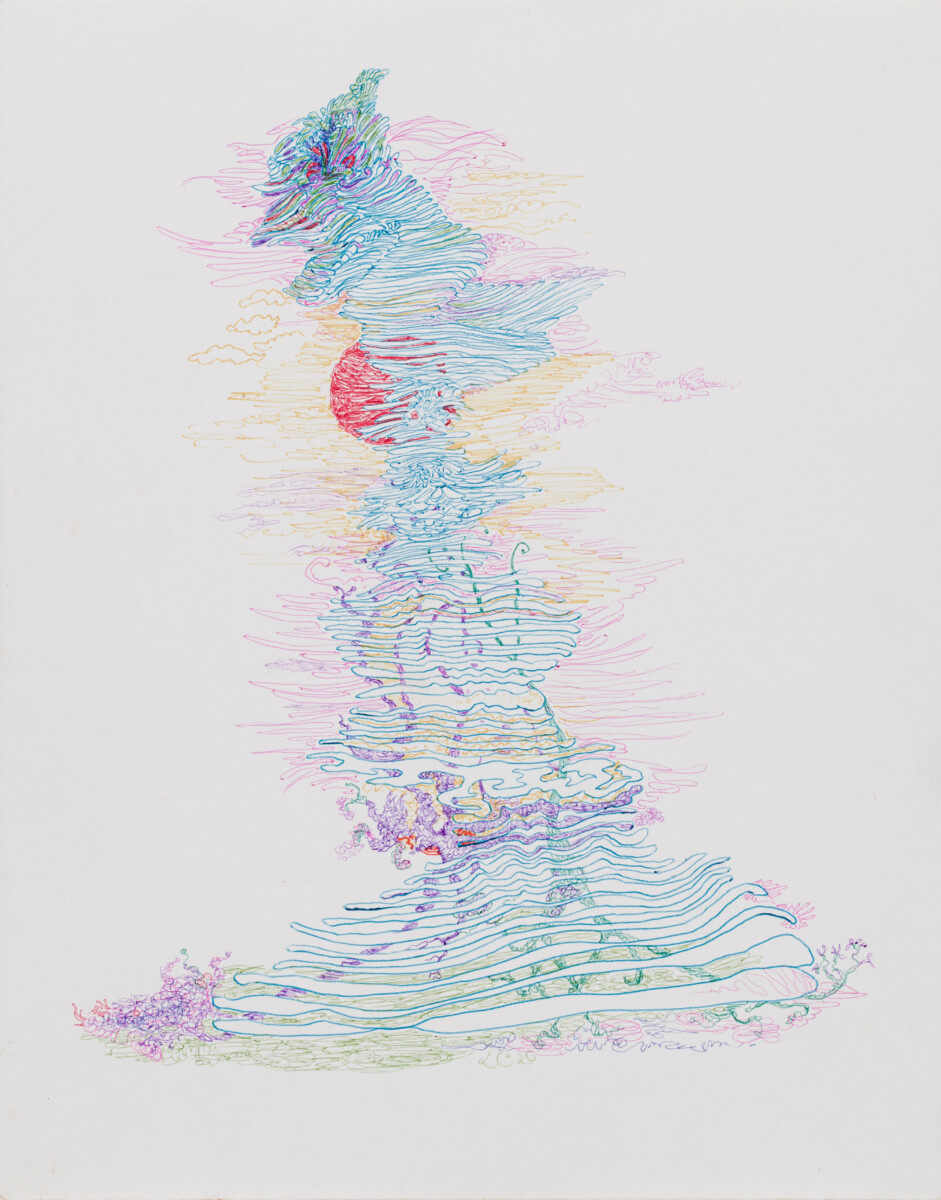
He continues to draw to this day, fashioning further psychedelic and visionary imagery now with colored pens. The addition of color to his drawings marks a new phase, as his earlier works are predominately in black ink on paper. Regardless, he has always experimented with color – all the way back to his 1960s posters. Some color experiments on the posters are more effective than others, but always he was playing with color over his defining linear sensibility. With the recent switch to colored pens, Conklin is able to fashion color images in real time, essentially determining the colors as he draws. He has come full circle back to pure drawing, but now with the added element of color, such as Sundance from 2020.
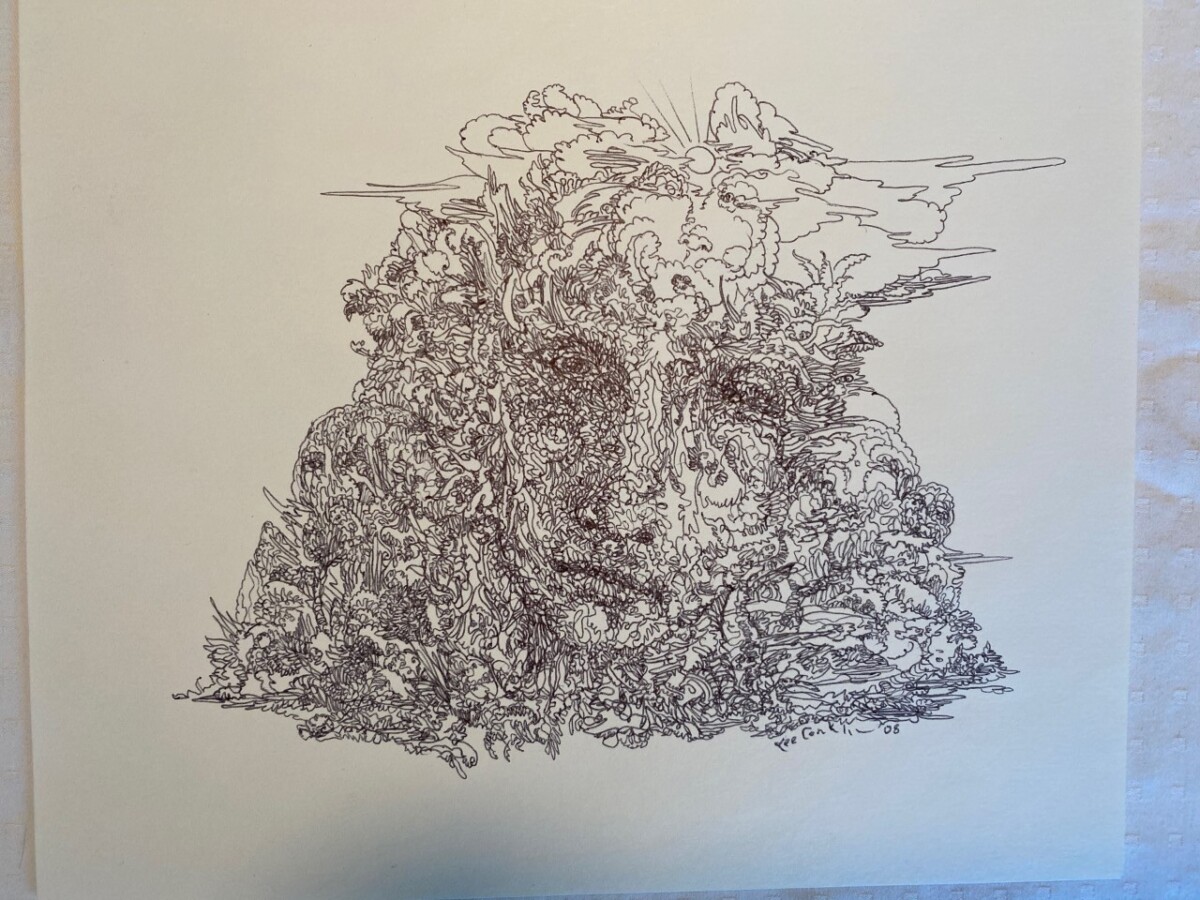
Face with Sun. 2008.
While best known for his 1960s poster related work, Lee Conklin deserves recognition for his long career as a visionary (psychedelic?) artist of the highest caliber – a formative influence on many succeeding artists of psychedelic leanings. With a career spanning seven centuries now, Lee Conklin is a veritable architect of psychedelic art and a major player in its early formulation and ongoing flourishing. His influence runs far and deep, despite his truly inimitable style and vision. He playfully gave artists a permission slip to unleash their most wild and fantastic visions. Brilliant draftsmen, supreme visionary, and all-around good person, Lee Conklin warrants further public awareness. Enjoy!
Scott B. Montgomery is Professor of Art History at the University of Denver. His research, publishing, and teaching concentrate around the two areas of medieval saints’ cults and psychedelic poster art of the 1960s. Dr. Montgomery – author, filmmaker, and lecturer, maintains a very busy professional schedule.
Gallery
Recent Articles

Loading...