VINYL RELICS: SHANTI by Shanti
VINYL RELICS: SHANTI by Shanti
Today, the sound of Eastern-style music combined with more traditional rock of the West is nothing new. But back in 1965, it was a completely fresh and exciting sound to Western ears, and we ate it up. Most fans would point to The Beatles as being the catalyst for this musical shift, and they certainly deserve credit for bringing this style to the masses. Were they the first? No, not really.
The Kinks “See My Friends” is often cited as one of the earliest Western rock songs to incorporate an Indian musical influence. Interestingly, no traditional Indian instruments were used in the recording, but with droning guitars, chant-like vocals and a rhythmic groove that created a hypnotic feel, it has all the elements of the quintessential “Indian” sound. As strong as the track is, it was soon overshadowed a few months later when The Beatles released “Norwegian Wood (This Bird Has Flown),” featuring a genuine Indian instrument—something that captured widespread attention. The sound was brought to the band by George Harrison, who’s rudimentary, yet effective sitar playing immediately ushered in a “new” style that others would quickly latch onto. Of course, Indian music is something Harrison would dabble in for the rest of his life.
Within a year of that one recording, you can count dozens of bands that hopped on the sitar-inspired bandwagon. The Stones’ “Paint It Black”, Donovan’s “Sunshine Superman”, Traffic’s “Hole in My Shoe”, Joe South’s “Games People Play.” The list goes on and on. For an interesting listen, check out the original version of The Yardbird’s “Heart Full of Soul” (1966). Jeff Beck’s stinging lead guitar is the centerpiece of the song but, originally, they recorded it with a sitar taking that lead line. Let’s just say they made a good production choice switching it to guitar.
The influence of Indian styles extended beyond copping a sitar sound here and there. It started becoming trendy, particularly with West coast bands who would incorporate this “Indian style” into their guitar solos. Check out John Cipollina from Quicksilver Messenger Service on their track “Who Do You Love” from 1969.
But while most bands dabbled with Indian styles here and there on a few tracks, one band went all-in. Shanti hailed from San Francisco, with two distinct set of musicians: the “Western/rock” artists – vocalist/guitarist Steve Haehl, lead guitarist Neil Seidel, bassist Steve Leach and drummer Frank Lupica joining forces with the “Eastern” musicians — classically trained Indian artist Zakir Hussain (tabla), Pranesh Khan (tabla) and Aashish Khan (Sarod). Drummer Lupica and vocalist Haehl had formerly spent time in the one-album-wonder band The Travel Agency, while Seidel had toured extensively with Gary Lewis and the Playboys.
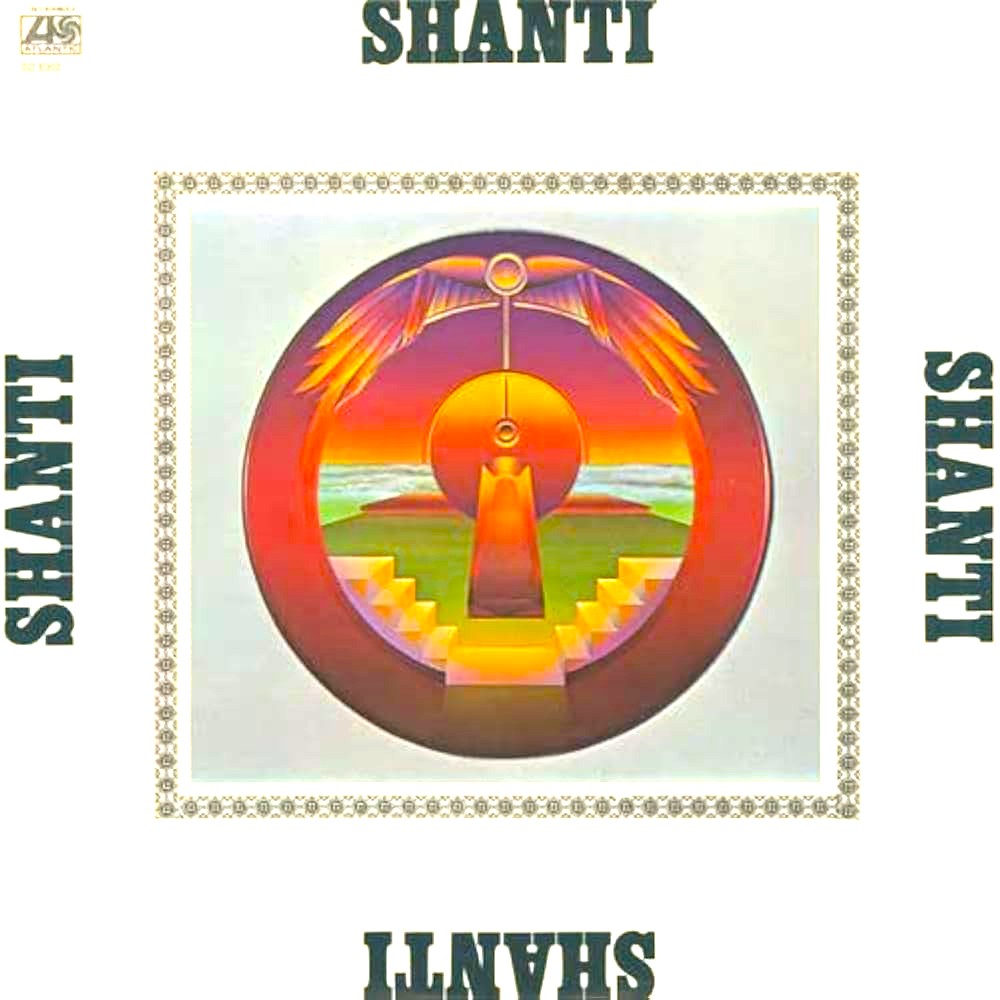
Originally, the label suggested the name Fresh Air, but Frank Lupica thought Shanti was more appropriate, given that it’s a Sanskrit word meaning “peace”.
I interviewed guitarist Neil Seidel for my program, Vinyl Relics. He got to know Frank previously when they were both in a band in Hawaii. When the mob got involved in things, he split for LA. and Frank soon followed.
Neil said that there are many stories about who formed Shanti, but he credits the idea to Frank who apparently was blown away when he saw the Indian musicians playing live.
They signed to Ahmet Ertegun’s Atlantic label and set about recording what would ultimately become their sole album.
Each side is highlighted with a long, very “Indian” style song. Side one’s lengthy track is titled “Innocence”, with side two featuring the self-titled track “Shanti”. The rest of the album is made up of more conventional sounding rock tracks, but all of them are coloured with the Indian instrumentation. It’s part raga-rock, part psych, part jam band, part folk-rock…and it all culminates into something truly unique. There’s even one track that has a bit of a country rock style, yet even it sounds unlike anything else when the Indian instruments are brought into the mix.
The band toured extensively to promote the album. Because they weren’t quite rock, and they weren’t quite folk, they were coupled with artists of diverse ranging styles, such as Joan Baez, Commander Cody, Humble Pie and Swamp Dogg just to name a few. They played one show with The New Riders of the Purple Sage with Jerry Garcia sitting in. Grateful Dead fans have been clamouring to find copies of that show as it was broadcast on KSAN. So far, no luck. “For years everybody’s been looking for that…it’s sort of like the lost ‘holy grail’ of Jerry Garcia”, Neil said.
The band was killer live, but Atlantic didn’t promote them well. “They didn’t have their heart in it”, Neil said. “We went around the country, and nobody knew we were coming. They had representatives from Atlantic Records who said ‘hey, you guys are really great, I wish we had of known you were coming’”.

With Atlantic losing interest, they almost got a second chance with none other than The Beatles’ Apple Records. On paper, this seems like it would have been the perfect fit. George Harrison came to a show and was very impressed. “He loved our band”, Neil said. If not for Ravi Shankar, a deal with Apple would likely have happened. Neil explained: “Ravi Shankar turned out to be our nemesis because (he) was worried that Aashish Khan – who was the crown prince of the sarod, and Zakir Hussain, the crown prince of the tabla, would get sucked up into the rock and roll world and lose their cred and motivation to be serious classical Indian musicians”. George considered his good friend’s concerns and decided to pass.
Without a new deal, the band splintered. The Indian musicians all went on to greater success and notoriety, playing on dozens of albums and teaming up with countless artists for various bands and sessions.
Frank Lupica rechristened himself as Francesco and dove into ambient music providing sound landscapes for films including The Thin Red Line and Kong: Skull Island.
Steve Leach went on to stints in other bands and some record producing. But in the 2000s, he re-emerged as Seasick Steve, playing a rustic blues style on a three-string guitar. He’s released several critically acclaimed albums.
Neil Seidel primarily moved on to session work and local band stuff, playing weddings, events, etc. “Anything to keep me off the road”, he said. He moved on to several successful businesses and wrote a couple of books. He eventually returned to recording and has released a couple of solo albums. You can hear and buy his music at www.neilseidel.com.
If you’ve ever found yourself grooving to one of George Harrison’s Indian-flavoured tunes, or other rock songs that incorporate that style, I suggest delving a little deeper. Shanti has a sound that is accessible to the average rock fan. It really is the best of both worlds (figuratively and literally).
The full story, including background stories of the songs with guitarist Neil Seidel, is available at Vinyl Relics on “epysode” 73. The show has a perfect 5-star rating on Spotify and Apple and is available there and all other podcast platforms. New epysodes drop weekly, exploring these types of under-the-radar albums. Tune in, turn on & drop by wherever you get your podcasts.
Gallery
Recent Articles

Artist Spotlight: Ivan Ivanov
•
October 8, 2026

Podcast: Sophia Ellowen
•
October 7, 2026

Loading...