Topology by HOL1D4Y
Topology by HOL1D4Y
HOL1D4Y is the solo project by American guitarist, composer, and producer Scott Holiday, best known as the founding member and lead guitarist of Rival Sons. Holiday is joined by keyboardist Jasse Nason and Rival Sons drummer Michael Miley. Arranged, performed and sang on every track, Holiday also tackles the production duties for Topology.
Is this a new side of the Rival Sons? What exactly are we dealing with here? The immediate impression is of compelling alternative rock infused with subtle psychedelic overtones. “Alternative rock” is, of course, a broad term, suggesting music that refuses to fit comfortably within conventional boundaries, breaks established rules and moves beyond straightforward formulas. Psychedelia, on the other hand, is more of an illustrative approach to sound achieved through form, harmony, instrumentation, effects, and space to create an altered musical perspective. HOL1D4Y certainly draws on some of these ingredients, but individual psychedelic touches are hardly enough to place the album neatly inside any particular box. And that resistance to easy categorization is one of its strengths. There is enough going on here to make the usual genre labels feel rather inadequate. It is worth digging a little deeper–because it’s definitely not the new side of Rival Sons!
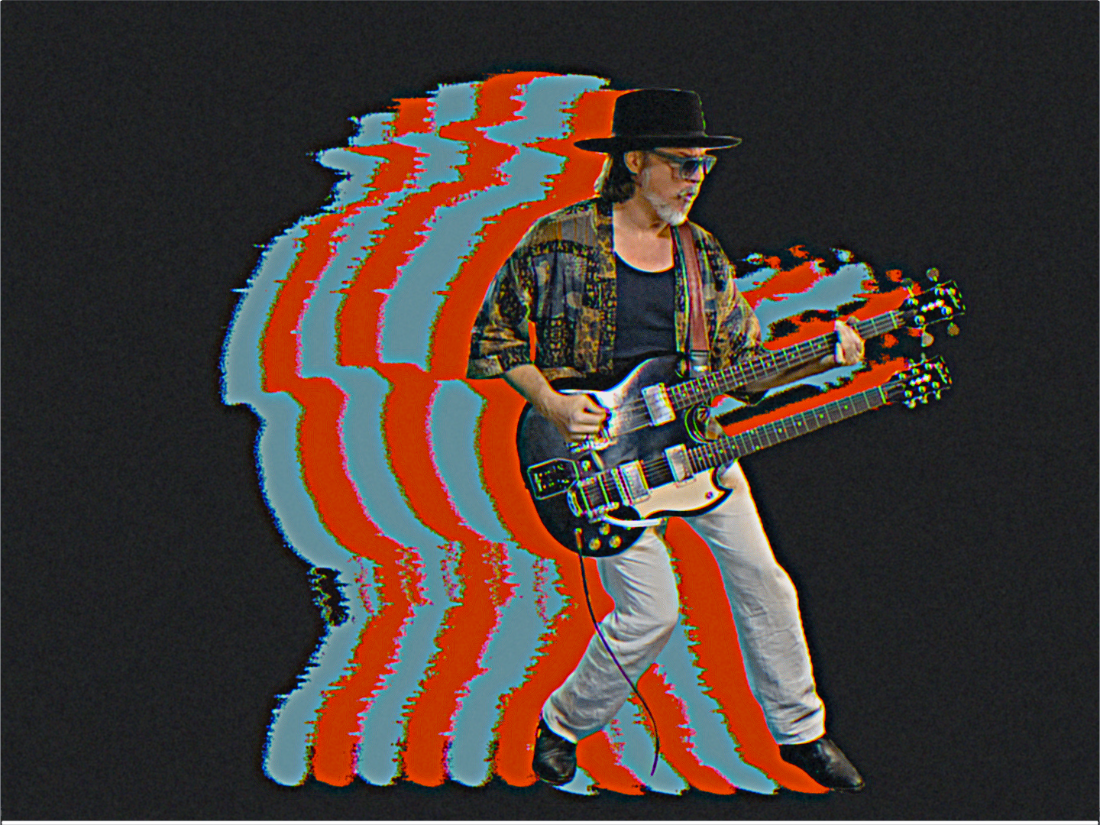
Right from the opening track, the production on Topology’s grabs the attention. Holiday builds his songs around chord progressions that rarely take the most obvious route, giving the material an unpredictable, harmonic character. The vocal arrangements are equally adventurous, frequently moving into layered, multi-part harmonies, sometimes sounding like early Kula Shaker and sometimes with melodic lines that seem to deliberately sidestep expectation. The voices are pushed through plenty of gain and coloured with effects ranging from telephone-style filtering and slapback to large room ambience and reverse processing. Alongside the guitars, the instrumentation includes synthesizers, while phasing and flanging add further movement to the sonic picture. Holiday also makes extensive use of stereo panning and spatial effects, turning the aural field into an active part of the arrangements rather than merely a place to position the instruments.
The songs are rhythm-driven compositions built around an infectious, feel-good groove or even rock riffs that effortlessly gets your feet moving, while at other moments the album drifts into dreamy, hypnotic territory reminiscent of the work of artists such as Noel Gallagher or Johnny Marr. There are also several instrumental pieces in which synthesizers and guitars, enhanced by carefully chosen effects, create a richly imaginative space-rock atmosphere with distinctly psychedelic undertones.
One of the album’s biggest surprises, and something that stands apart somewhat from the rest of the material, is the instrumental track “Crism.” It opens with a psychedelic dialogue between bass, drums, piano and guitar treated with a Uni-Vibe effect. The introduction immediately evokes the kind of exploratory atmosphere associated with artists such as the Grateful Dead or the German band Agitation Free. But before long, the piece takes an unexpected turn, developing into beautiful, emotional, and deeply nostalgic blues, driven by some particularly expressive guitar work.
Rick Horn
During the second half of this eleven-minute instrumental dialogue, the mood gradually becomes more overtly psychedelic. The drummer becomes increasingly expressive, while the instruments seem to wander into abstract sonic spaces, eventually dissolving into a cosmic synthesizer pad. The closing track, “Love of Separation”, is also instrumental. It is an atmospheric piece built around acoustic guitar, shakers, rain stick, and tingsha, all suspended in a broad, warm acoustic space. It provides a gentle and immersive way to let the album’s impressions settle – a perfect soundtrack for quietly winding down after the journey.
After several listens – and it is interesting enough to make you want to come back to it – a clearer picture begins to emerge. Topology is fundamentally a rock record, but with a strong emphasis on sonic experimentation through a wide range of effects. Saturation is everywhere: guitars, drums, vocals, and other instruments are frequently coated in a warm, analogue-sounding layer of tape and valves gain. Instruments and vocals are placed within a large, clearly audible acoustic space created by reverb and delay, with interesting use of the stereo field, while the occasional almost-mono character of the drums adds another interesting contradiction to the otherwise expansive production.
The vocals are perhaps the album’s most consistent sonic signature. They are rarely presented cleanly. Instead, they arrive distorted, saturated, layered and surrounded by harmonies and backing vocals. Combined with Holiday’s frequent use of unconventional chord progressions, this approach turns otherwise recognizable rock structures into something considerably stranger and more psychedelic.
Rick Horn
Synthesizers and drum machines add yet another layer to the equation. None of these elements dominate the record, but their interaction makes Topology difficult to reduce to a convenient genre description. Holiday uses familiar rock vocabulary as a starting point and then bends it, colors it and sends it into less predictable territory and perhaps that’s exactly the point.
Despite its immaculate production, Topology retains something of the spirit of a garage record – raw, immediate and slightly unpredictable – while simultaneously revealing an impressive degree of studio craft.
It’s clear that Scott Holiday had a strong concept for this album, the way he makes familiar rock vocabulary distorted, saturated, spatialized, and rearranged into something personal. Topology may not be a revolution in the field of alternative rock but, in the crowded field of alternative and neo-psychedelic rock releases, the conceptual strength, buoyed by its production value, is more than enough to make this album worth seeking out.
Topology releases today! Friday, September 25th, on Sacred Tongue Recordings.
Piotr Dudzikowski is a sound engineer, producer, composer, musician, and founder of the Polish psychedelic band More Experience. He holds a PhD in art history and works as a university lecturer.
Gallery
Recent Articles

Loading...